
Anger Management Therapy in Hackney E8
Written by Izabela Hunter, MA, BACP, UKCP, Child, Adolescent & Adult Psychotherapist
Last reviewed: July 2026
Looking for help with anger?
If you’re looking for anger management support in Hackney, Space To Be You have many therapists who can help.
We’re located on Mare Street, in the heart of Hackney, close to several train and bus routes.
Struggling with your anger does not make you a bad person. Anger is a normal emotion, and it’s something you can learn to handle differently.
The therapist-client fit matters to us, and we’re here to help you find the right person.
If you’d like to be matched with an anger management therapist, click below and fill in your details.
Alternatively, you can search our Hackney therapist directory, which includes therapists experienced in anger work.
What is anger management?
Anger is a normal, healthy human emotion. It is not a mental health condition nor is it a diagnosis.
Everyone feels it.
The issue you might be facing isn’t anger itself, but how often it shows up, how intense it gets, and what you do with it.
Anger management isn’t a punishment, and it isn’t only for people who have been violent.
In fact the vast majority of people who seek support have not hurt anyone.
Anger management is simply a practical, collaborative process: you work with a therapist to understand what drives your anger and then build skills to respond differently, usually over a course of several sessions.
There’s also no pill to take for anger. Medication is only relevant if there’s an underlying condition such as depression, which is a conversation for your GP. For anger itself, talking therapy is the best form of support.
Should I see an anger management therapist?
Many people who look for support aren’t sure whether they deserve it, or need it.
A useful way to decide is to look at three things:
- How often your anger flares
- How intense it gets
- How you feel afterwards
If you feel regret or shame, then those are signals that are worth paying attention to, so it might be worth talking to someone if any of the following are true:
- People close to you seem to walk on eggshells around you, or have said your anger frightens them
- You go from calm to furious very quickly, with little warning
- Your relationships, work, or parenting are being strained by your outbursts
- You often feel physical tension when angry, for example a racing heart, clenched jaw, or tight chest
- You use alcohol or other substances to take the edge off
None of these mean something is “wrong” with you. They’re simply signs that support could help.
What is your anger telling you?
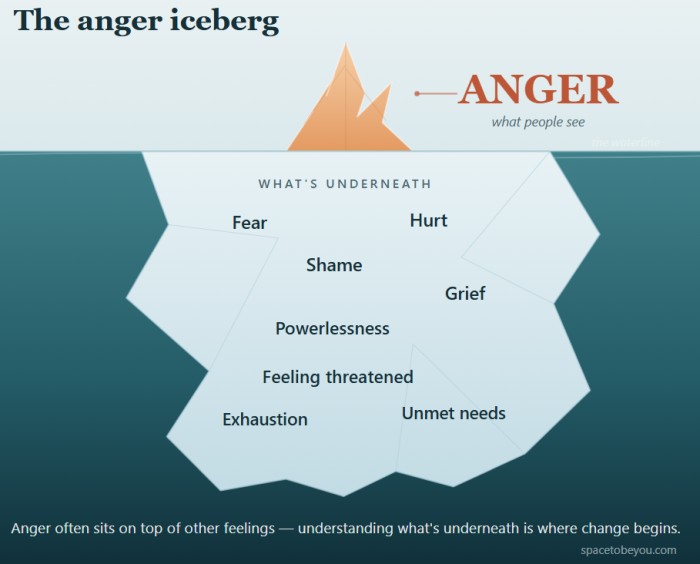
Anger rarely occurs in isolation. It usually sits on top of something else, and understanding what’s underneath is where change starts.
Underneath an outburst of anger, you’ll often find feelings of fear, hurt, shame, or a sense of powerlessness. Anger can feel safer than those feelings because it’s active rather than helpless.
That is not a weakness or something that is wrong, it is a very human way of self-protection.
The below “anger iceberg” diagram aims to visualise this:
Sometimes anger is a manifestation of something worth paying attention to, such as: trauma or PTSD, depression (which often shows up as irritability), chronic stress or burnout, grief, or the emotional dysregulation linked to ADHD.
Naming these isn’t the same as diagnosing yourself, but if any of them resonate, they’re worth exploring with a professional therapist.
And if you feel you’re “just an angry person”, then you shouldn’t despair as anger responses are usually learned patterns, often picked up in childhood, and patterns can be changed.
What causes anger?
Alongside the feelings underneath, everyday situations can light the fuse.
The NHS points to a familiar set of circumstances:
- being treated unfairly and feeling powerless to change it
- sustained pressures such as money, work, or housing worries
- family patterns of behaviour learned in childhood
- past frightening or traumatic events.
When you’re already stretched, small things that normally wouldn’t can tip you over the edge. That doesn’t make your anger irrational, it makes it understandable.
What does anger management therapy involve?
Therapy helps you learn how to create space between the trigger and the reaction. You may learn techniques to spot your early warning signs, get to know your specific triggers, question the “it’s not fair” thoughts that pour fuel on the fire, and then work to repair things afterwards.
It’s also worth being honest about what it won’t do: Therapy won’t stop you feeling angry, and it isn’t a quick fix. Anger is healthy, the goal is to choose to control it, not switch it off.
“Anger management therapy” isn’t about one fixed type either. Depending on what suits you, a therapist might draw on CBT therapy (triggers and thoughts), Dialectical Behaviour Therapy (DBT) (managing strong emotions), compassion-focused therapy (for the shame underneath), or psychodynamic and couples therapy (roots and relationship patterns).
How does anger affect your health and relationships?
Left unmanaged, anger can wear down the things you want to protect the most, such as closeness in relationships, being the kind of parent you want to be, your reputation at work, and your own self-respect. Many people go through an exhausting loop of outburst, then guilt, then resentment.
Anger affects the body too. It turns on your stress response such as increasing your heart rate and blood pressure, and your muscles tense.
When that happens regularly, it can disrupt sleep, create tension, induce headaches, and nudge people towards alcohol.
None of this is meant to alarm you; it’s simply another reason that getting support is worth it, for your body as much as your peace of mind.
Where does anger show up?
Anger looks different for different people:
- In relationships and at home – where our guard is down and old wounds reopen most easily. Couples therapy or family therapy sessions can help here
- For many men – anger becomes the one emotion that feels allowed when sadness or fear feel off limits
- For parents – it’s often mixed with exhaustion, guilt, and past patterns they’re trying hard not to repeat
- With neurodivergence – such as the fast, intense emotional responses linked to ADHD
A Hackney anger therapist will work to fit you, providing individual work for some, or couples or family sessions for others.
What are your options in Hackney, including free support?
You have real choices, and some are free.
City and Hackney NHS Talking Therapies offers free, confidential therapy you can refer yourself to, with no GP referral needed if you’re 18 or over and registered with a local GP. It’s worth pointing out that the service is primarily geared towards anxiety and depression, so if anger is your main difficulty, you may be pointed to your GP for a local anger course or to other community services such as Mind in the City, Hackney and Waltham Forest.
Private anger management therapy in Hackney at Space To Be You suits people who want quicker access, the choice of a range of therapists, and room to work at their own pace.
We’re on Mare Street in Hackney (E8), and our anger therapists offer sessions in person or online. We can help match you with someone whose approach fits what you’re dealing with; just click the Find a Therapist button.
When should you seek help for anger?
Reaching out early is sensible, not a last resort. It’s worth acting quickly if your anger is escalating, you sometimes feel out of control, you’re using alcohol or substances to cope, or your anger is frightening the people around you.
If anger ever brings thoughts of harming yourself or someone else, please treat it as urgent. You can call the NHS on 111, or 999 in an emergency.
If you’re worried about your own behaviour towards a partner, the Respect Phoneline offers confidential, non-judgemental advice on 0808 802 4040.
Our therapists offer support for anger, but not court-accredited perpetrator programmes. If you need a mandated or accredited programme, the Respect team can also point you in the right direction.
How to find the right anger therapist in Hackney
- Search our directory – Our Hackney therapist directory lists therapists experienced in anger and emotional regulation.
- Check therapist credentials – Look for registration with the BACP, UKCP, or HCPC. All of our therapists are registered with a UK body, except for trainee therapists which is clearly labelled in their profile.
- Book an initial consultation – This lets you see whether the client/therapist fit feels right. This is just a conversation, not a commitment.
- Consider the approach and practicalities – Choose the type of therapy, location, and timing that suit you.
If the first therapist isn’t quite right, keep looking until you find someone you feel comfortable with; they will not be offended.
For more general information, the NHS guide Get help with anger is a helpful starting point.
NEED HELP CHOOSING AN ANGER MANAGEMENT THERAPIST?
If you’d like to be matched with a therapist, please click below or contact one directly on our therapist directory page.