
Psychotherapy in Hackney E8
Space To Be You have some of the best psychotherapists in Hackney to choose from.
The therapist-client fit is important to us and we’re here to help you find the right therapist.
If you’d like to be matched with a therapist, please click the button below and fill out your details.
Alternatively, you can search for psychotherapists and counsellors on our therapist directory page.
Written by Izabela Hunter, MA, BACP, UKCP, Child, Adolescent & Adult Psychotherapist
Last reviewed: July 2026
Looking for help choosing a psychotherapist?
 If you are reading this, you may already sense that something needs to change, but you may not know where to begin or what help you need.
That’s a very common place to start from, and the industry jargon alone can be confusing: psychotherapist, counsellor, psychologist, psychiatrist, CBT, psychodynamic etc.
This guide is here to make things simpler and clearer.
Below, we explain what psychotherapy is, what the main approaches are, who each approach can help, how to find the right client/therapist fit, and how to access support in Hackney, whether privately or through the NHS.
Space To Be You is a therapy centre on Mare Street in Hackney (E8), offering in-person and online sessions, but wherever you choose to go, our aim here is help you take the first step.
What is psychotherapy?
Psychotherapy is a regular, confidential space to talk with a trained professional about what you are finding difficult in your life.
Together, you make sense of those difficulties and work towards a positive change. It can also be called “talking therapy,” and it can take place in person or online.
You do not need a diagnosis, a label, or to be in crisis to benefit from psychotherapy.
Plenty of people come simply because they feel stuck, heavy, or cannot make a change by themselves. Sessions can be one-to-one, with a couple, or in a group, depending on what you need.
Your sessions with a psychotherapist will almost always be weekly, and last for 50 minutes. Some people come for a short, focused piece of work that might last a few weeks, while others can see their therapists for many months, or even years, to explore deeper patterns.
There is no single “correct” length, and a good therapist will talk this through with you.
Psychotherapy vs counselling – what’s the difference?
This is a very common question, and the honest answer is that the two terms overlap a great deal.
In the UK there is no legal fixed line between them, and many therapists use both words to describe similar work.
Counselling – As a loose definition, “counselling” is often used for shorter-term or situational support, for example, working through a bereavement or a specific difficult period.
Psychotherapy – Whereas “psychotherapy” is often for longer-term, deeper work to understand underlying patterns. But this is a general tendency, not a firm rule.
What matters far more than the label is the therapist’s training, registration, and whether the relationship feels right for you.
Both counselling and psychotherapy can be offered by highly qualified professionals.
Psychotherapist vs psychologist vs psychiatrist
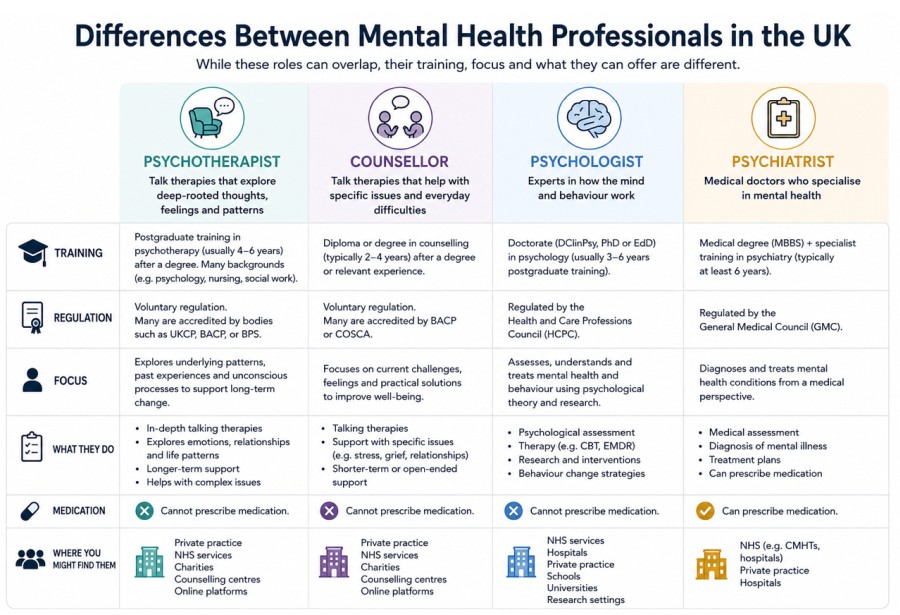
These roles are easy to mix up and many people struggle to understand the difference, so here’s a straightforward comparison:
- A psychiatrist – is a medical doctor who specialises in mental health. They can diagnose conditions and prescribe medication.
- A psychologist – has studied psychology to degree level and beyond. They can diagnose conditions, but they cannot prescribe medication. Depending on their training, they may work in research, assessment, or as a therapist. A clinical psychologist or counselling psychologist can also offer talking therapy.
- A psychotherapist or counsellor – is trained specifically in talking therapy. They cannot diagnose conditions or prescribe medication.
One important point to note: in the UK, “psychotherapist” and “counsellor” are not legally protected titles. In principle, anyone can use them, which is why registration or accreditation with a recognised professional body matters so much; more on that below.
The following diagram comparing various UK mental health professionals might be helpful for more information:
What can a psychotherapist help with?
People come to therapy for a large number of reasons. You do not have to fit neatly into a particular category, but some common reasons include:
- Anxiety, worry, and panic – see our guide to anxiety therapy in Hackney
- Low mood and depression – see depression therapy in Hackney
- Stress and burnout – see our therapy for stress in Hackney page
- Trauma – and difficult past experiences. See PTSD and trauma therapy in Hackney
- Relationship difficulties – whether with a partner, family, or others
- Bereavement and loss – see our bereavement therapy page
- Life transitions – a job change, a move, becoming a parent, retirement
- Self-esteem – and a persistent sense of not being good enough
- ADHD-related challenges — see ADHD therapy in Hackney
A note on language: stress and burnout are often signs that your ability to cope is under strain, rather than a formal diagnosis. Burnout is recognised by the World Health Organization as an occupational phenomenon, rather than a medical condition. However, that doesn’t make it any less real or worth addressing.
Types of psychotherapy; which one is right for me?
 Here is a reassuring truth: there is no single best type of therapy.
The right approach depends on you, on what you are bringing to therapy, and on the relationship you build with your psychotherapist.
A good therapist will help you find the right fit rather than sell you one method.
Below are some short explanations of the main approaches. We have provided links to more in-depth guides where we have one.
Cognitive Behavioural Therapy (CBT)
CBT is structured, practical, and focuses on the present rather than analysing your past. It looks at the connections between your thoughts, feelings, and behaviour, and teaches skills that you can utilise between your regular sessions. It has a strong body of evidence of its effectiveness and is often offered as the first therapy option for many anxiety disorders, as well as depression. Read more about CBT in Hackney.
Psychodynamic psychotherapy
This approach explores your past, and how patterns that you might not be aware of, shape how you feel and relate to things today. It tends to be a more open-ended and exploratory type of psychotherapy. Many people find it helpful for long-standing difficulties that keep repeating. Read more about psychodynamic therapy in Hackney.
Humanistic, person-centred, and Gestalt therapy
These approaches focus on the present moment, on the relationship between you and the therapist, and also on your own capacity to grow as a person. They are less about a technique and more about being genuinely heard and understood by your therapist. Read more about Gestalt therapy in Hackney.
Integrative therapy
An integrative therapist blends elements from different approaches and tailors the work to you as an individual, rather than fitting you to a single method. Read more about integrative psychotherapy in Hackney.
EMDR
Eye Movement Desensitisation and Reprocessing (EMDR) is a structured therapy designed to help the mind process distressing or difficult memories, often used for trauma and post-traumatic stress. Read more about EMDR in Hackney.
Couples and relationship therapy
Couples therapy, relationships therapy or marriage counselling gives two people a space to understand recurring conflicts, communicate more openly, and decide how they want to move forward together. Read more about couples therapy in Hackney.
A note on the “best therapy” debate
You may read online that one therapy is clearly superior to the rest. It is worth understanding the genuine disagreement behind this.
On one side of the argument, some people point to CBT’s body of evidence as the “gold standard.” It has the largest trial base and the widest set of NICE (National Institute for Health and Care Excellence) recommendations. NICE also ranks it among the most clinically effective and cost effective therapy for depression.
On the other side, many therapists and researchers argue the evidence does not show CBT to be reliably better than other established therapies. When therapy approaches are looked at head to head, the differences are often very small. However, what consistently predicts a good therapeutic outcome is the quality of the relationship between you and your therapist, and how well the approach fits you.
Our own view sits with the evidence: fit and a proper conversation with a therapist matter more than declaring a simple “best therapy”. If you are unsure of what therapy type might work for you, that’s a good thing to raise in your introductory call or first session.
Does psychotherapy work?
Talking therapies are very well researched and are recommended by NICE for common conditions such as anxiety and depression.
For many of these problems, the NHS states that talking therapies can even be as effective as medication, although the right choice depends on the person, and we recommend discussing the medication option with your GP in the first instance.
To give you an idea of the success rate, the NHS Talking Therapies programme reports that around 50% of all those who completed their treatment made a recovery, based on its 2024-25 national figures.
While that figure is impressive, it does also tell an honest truth: that therapy is not a guaranteed fix, and results can vary from person to person.
In addition, we’d like to point out a few other honest points that you should be aware of:
> Therapy takes time and some effort, and progress is not typically a straight line.
> One of the most consistent predictors of success (across all therapy approaches), is the strength of the relationship between you and your therapist.
> To be clear, Space To Be You does not offer medication advice or prescriptions. Anything to do with prescriptions is a conversation for your GP or a suitably qualified psychiatrist.
How to choose a psychotherapist in Hackney
Choosing the right therapist is straight forward when you’re armed with a little information, so here is a simple checklist to help you:
– Check registration or accreditation – Because the titles are not legally protected, look for membership of a recognised body such as the BACP, UKCP, HCPC, BABCP. These bodies set training standards and ethical codes for therapists in the UK.
– Match your needs to the right approach – Use the information above as a starting point, but ask therapists for more information on how they work when on your initial consultation or introductory call.
– Prioritise the fit – Most therapists offer a free or low-cost initial consultation. It is completely fine to meet more than one, and to change therapist if it does not feel right. That is part of their job and they won’t be offended.
– Consider practical factors – Location and transport, in-person versus online, session times, and cost all matter. A convenient, practical arrangement helps you keep going each week.
Are Space To Be You’s therapists qualified and registered?
Yes. Every therapist at Space To Be You is registered or accredited with a recognised professional UK body, works within a formal ethical framework such as the BACP Ethical Framework, and takes part in regular supervision and continuing professional development (CPD).
This is the standard we hold across our practice. The only exception is for trainee therapists who are marked clearly in their profile. Visit our Hackney therapists directory page to see all of our practitioners.
Private psychotherapy vs NHS options in Hackney
There is no single correct route, only one that fits your situation. Here is a quick look at what is available locally:
NHS talking therapies (self-referral, free)
City & Hackney Talking Therapies is the free NHS service for the boroughs of Hackney and the City of London, and was previously called Talk Changes, but renamed in 2023. You can refer yourself directly and you do not need to go through your GP first.
The service provides support for adults registered with a City of London or Hackney GP who are experiencing common problems such as anxiety and depression. It offers therapies including CBT, counselling for depression, interpersonal therapy, and mindfulness-based approaches.
The service claims that most people wait no more than around two weeks for an initial assessment, however it’s worth pointing out that the waiting list for treatment can be much longer. For many people, this is a sensible and effective first step, and it is well worth trying.
NHS specialist psychotherapy (referral only)
For longer-term or more complex needs, the City and Hackney also has a specialist NHS psychotherapy service based at the Donald Winnicott Centre in E2. It offers several approaches such as psychodynamic psychotherapy and group work. Access to this service is by professional referral, usually through your GP, rather than self-referral.
Low-cost and community options
If cost is a barrier, Hackney has some low-cost routes worth exploring, including training clinics where sessions are delivered by supervised trainee therapists, and community or voluntary-sector services. Availability changes over time, so it is best to check current providers directly when you are ready to look.
When private therapy makes sense
It’s not necessarily true that private therapy is better than the NHS; it is just different, and it suits some situations well.
Private psychotherapy gives you a wider choice of therapist and approach, usually provides much shorter waits, and offers more flexibility over timing, session length, and how long you continue.
For longer term or open-ended work with the same therapist, private therapy is often a better option as it provides more continuity.
What to expect from your first session
A first psychotherapy session is mostly a conversation. Your therapist will want to understand what has brought you to therapy, a little about your background, and what you are hoping to achieve. There is no script and no pressure to share more than you are ready to.
It is also your chance to get a feel for the therapist and whether the fit feels right, which is very important.
Sessions are confidential and within the UK’s professional and legal limits, which your therapist will explain. The pace is led by you and you choose how quickly things move with your therapist.
Psychotherapy at Space To Be You in Hackney
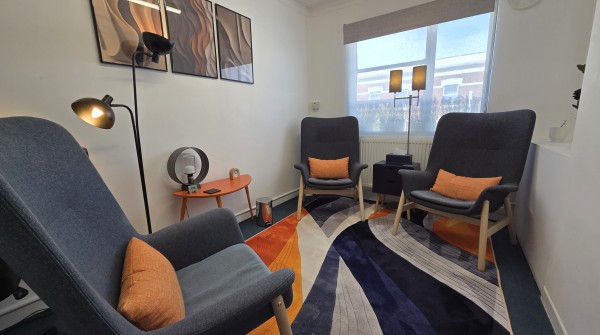 Space To Be You is based on Mare Street in Hackney (E8), on the site of St Joseph’s Hospice, with a large number of private consulting rooms. We offer both in-person and online sessions, and we’re easy to reach from London Fields, Cambridge Heath, Hackney Central, and Bethnal Green stations.
If you are not sure which therapist or approach fits you, our matching service can help. Tell us a little about what you are looking for, and we will suggest therapists who could be a good fit. Just click on the green Find a Therapist button below.
Many of our therapists can offer a first appointment within days.
Fees and getting started
Fees vary between therapists, so the most accurate figures are on each therapist’s own profile, but typically you should expect to pay between £50 and £130 for psychotherapy or counselling.
Most of our therapists offer a free or low-cost initial consultation, and some offer sliding-scale rates for those on a limited income.
Sessions may also be covered by private healthcare schemes such as Bupa or Vitality, depending on your policy and the individual therapist.
When you are ready, you can browse our therapists. If it would help to plan your visit, see our getting here page.
> If you need urgent help: if you are in crisis or worried about your safety, you do not have to wait for a therapy appointment. Contact your GP, call NHS 111 (and select the mental health option), or call the Samaritans free on 116 123 at any time. In an emergency, call 999 or go to your nearest A&E.
Frequently asked questions
Is psychotherapy the same as counselling?
Not exactly, but the terms overlap a lot and are often used interchangeably. In the UK the terms are not fixed. As a rough guide, counselling is sometimes shorter-term or focused on a specific issue, while psychotherapy is sometimes longer-term work on deeper patterns. Both can be delivered by highly qualified, registered practitioners, so the label doesn’t matter as much as the therapist’s training and the client/therapist fit.
How much does psychotherapy cost in Hackney?
Fees vary between therapists and approaches, but typically between £50 and £130 for a 50 minute session, once per week. Many therapists offer a free or low-cost initial consultation, and some offer sliding-scale or trainee rates for people on a lower income. Sessions may also be covered by private healthcare schemes such as Bupa or Vitality, depending on your policy. Free NHS talking therapy is also available in Hackney and the City.
Can I get psychotherapy on the NHS in Hackney?
Yes. City & Hackney Talking Therapies is the free NHS service for the borough, and you can refer yourself directly without going through your GP. It supports adults registered with a City & Hackney GP who are experiencing common problems such as anxiety and depression. For longer-term or more complex needs, there is also a specialist NHS psychotherapy service accessed by GP referral. The waiting list can be long, however.
How long does psychotherapy take?
There is no fixed length. Some people come for a short, focused piece of work over a few weeks, while others continue for several months or longer to explore deeper patterns. Your therapist will discuss this with you and review it as you go. What matters is the pace that you set, rather than the number of sessions.
How do I know which type of therapy I need?
You do not need to decide alone or in advance. There is no single “best” type of therapy, and the right approach depends on you, your situation, and the relationship with your therapist. A good starting point is a first conversation, where you can describe what you are struggling with and ask how the therapist might work with you. We are here to help you find a suitable therapist so click the Find a Therapist button on this page.
Do I need a diagnosis or a GP referral to start?
No. You do not need a diagnosis, a referral, or a crisis to begin private therapy; you can get in touch directly. Many people come simply because something feels stuck or off. For the free NHS service in Hackney, you can also refer yourself without a GP referral.
Is what I say confidential?
Yes. Therapy is confidential, within the usual professional and legal limits, which your therapist will explain at the start. In rare situations, such as a serious risk to your safety or someone else’s, a therapist may need to share information, but they would normally aim to discuss this with you first.
Can I have sessions online?
Yes. Space To Be You offers in-person sessions in Hackney, as well as online sessions. Online therapy can work well if you prefer to be at home, have a busy schedule, or live further away. You can talk through which option suits you best when you get in touch.
NEED HELP CHOOSING A PSYCHOTHERAPIST?
If you’d like to be matched with a therapist, please click below or contact one directly on our therapist directory page.