
Therapy for Stress in Hackney E8
Space To Be You have some of the best stress therapists and counsellors in Hackney to choose from.
The therapist-client fit is important to us and we’re here to help you find the right therapist.
If you’d like to be matched with a therapist, please click the button below and fill out your details.
Alternatively, you can search for stress therapists on our directory of psychotherapists and counsellors page.
Written by Izabela Hunter, MA, BACP, UKCP, Child, Adolescent & Adult Psychotherapist
Last reviewed: July 2026
Looking for help with your stress?

If stress has become the background noise of your daily life, you are not alone — and you are not weak for finding it hard. Space To Be You offers stress-focused counselling and psychotherapy in the heart of Hackney, with therapy rooms on Mare Street (E8) and online sessions across East London. Reaching out early, before things reach breaking point, is a sensible and proactive step. It isn’t an overreaction, and you don’t have to be in crisis to deserve support.
This page explains what stress is, how to recognise when it has tipped into something worth addressing, and the honest truth about how therapy helps. We’ve also set out your options locally, including the free NHS route, so you can make the choice that’s right for you.
What we mean by stress
Stress as a normal response to pressure
Stress is usually a reaction to mental or emotional pressure. The NHS describes it as what we feel when we’re under pressure or feel we’re losing control over something. It is a normal human response, experienced by everyone at some point, and is not a sign that you’re failing to cope with a life that others might find easy.
When you feel under pressure, your body releases stress hormones such as adrenaline and cortisol. This is what’s known as the fight-or-flight response, and in short bursts it can be useful. The response sharpens focus and might help you meet a deadline or handle a difficult moment.
The problem comes when the pressure doesn’t go away and your body stays switched on.
Acute vs chronic stress
Acute stress is short-term. It’s normally tied to a specific event such as a job interview, a public speech, or a house move. It usually eases once the event has passed, and this kind of stress is a normal part of life.
Chronic stress is different. It builds up over weeks or months, often from ongoing pressures like money worries, a demanding job, or caring for someone.
When stress becomes constant, stress hormones can stay elevated, and over time this can affect your sleep, mood, and physical health.
Recognising the shift from short-term to prolonged stress is often the first step towards doing something about it.
The following diagram explains this process in a little more detail:
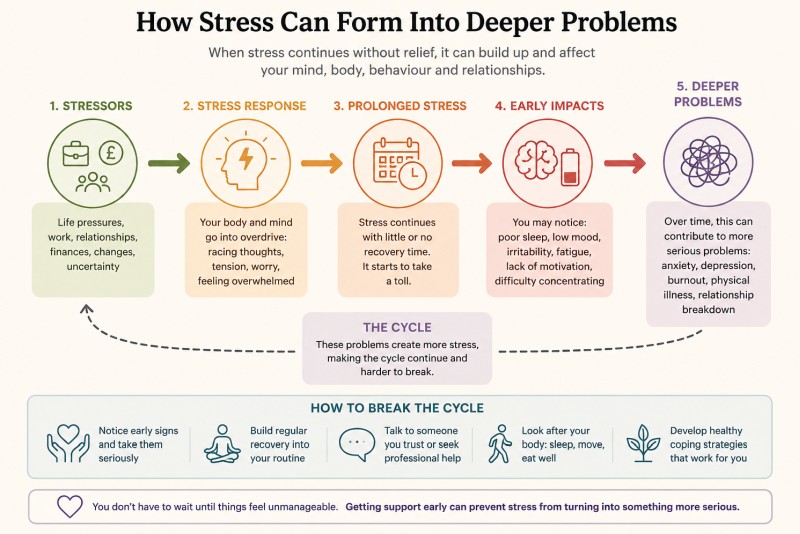
Signs stress may be affecting you
Stress shows up differently in everyone, and it can be surprisingly hard to spot in yourself.
You might recognise some of the signs below. This isn’t a checklist or diagnosis; it’s simply a way to notice patterns that you might not pay attention to:
Physical signs
– Headaches, muscle tension, or unexplained aches
– Trouble sleeping, or feeling tired even after rest
– A racing or pounding heart, or shallow breathing
– Stomach problems, changes in appetite, or feeling run down
Emotional and mental signs
– Feeling overwhelmed, wound up, or on edge
– Irritability, or a shorter fuse than usual
– Constant worry, racing thoughts, or difficulty switching off
– Trouble concentrating or making everyday decisions
Behavioural signs
– Withdrawing from people, or cancelling plans that you would normally enjoy
– Eating more or less than normal
– Drinking or smoking more to help cope
– Falling behind on things that you are normally on top of
If several of these feel familiar and they’ve been going on for a while, it may be worth taking your stress seriously rather than dismissing them or putting on a brave face.
Stress vs. anxiety
People often use “stress” and “anxiety” to mean the same thing, and the two do overlap, but there’s a useful distinction.
Stress is usually tied to an identifiable pressure; a specific situation you can point to. It then tends to ease once that pressure lifts.
Anxiety is more about worry and a sense of threat that is experienced even when there’s no obvious cause, often focused on what might happen in the future.
They are both closely linked however. Prolonged, unmanaged stress can develop into anxiety or low mood, which is one reason it really helps to address stress before it becomes takes hold.
Where stress has expanded into an anxiety disorder or depression, there are well-established, evidence-based therapies that can help, and that’s worth knowing, rather than fearing.
When you look like you’re coping (high-functioning stress)
Not all stress looks like someone falling apart. Some of the most stretched people appear to be managing perfectly well, meeting deadlines, showing up for everyone, and generally holding it together. This is sometimes called high-functioning stress, and it’s easy to miss in yourself precisely because you’re still functioning.
You might recognise it. The freelancer or creative who never quite switches off. The renter bracing for the next move and the next rent rise. The person holding down a demanding job while caring for family, running on adrenaline and managing multiple to-do lists. On the outside, coping. Underneath, wired, tired, and quietly running on empty.
The catch is that “still coping” becomes the reason not to ask for help.
If you’re getting through the week, admitting that you’re struggling can feel self-indulgent. Many people wait until something gives, such as a bout of tears, a health scare, reaching the point of having nothing left in the tank, before they seek help.
You don’t have to earn therapy by reaching the point of break down first.
Living under a constant low hum of pressure takes a real toll on the body and the mind, even when nothing looks wrong from the outside.
Over time that steady load, what researchers call “allostatic load”, can quietly wear down your sleep, mood, and overall health.
Noticing high-functioning stress early isn’t weakness. It’s self-awareness, and it’s actually the point where therapy helps most, before the cost of not acting catches up with you.
When is it time to seek therapy for stress?
There’s no single threshold, and you don’t need to wait until you’re at breaking point.
It may be time to reach out for support if your stress is:
- Persistent – lasts for weeks rather than days, without easing
- Overwhelming – leaving you feeling unable to cope
- Affecting daily life – disrupting your sleep, work, or relationships
- Showing up physically – through tension, headaches, or exhaustion
- Changing into anxiety or low mood – where worry or flatness has crept in
Importantly, stress is not a mental-health diagnosis, and you don’t need a diagnosis to benefit from psychotherapy or counselling.
You don’t have to justify your struggle or prove it’s now “bad enough to get help”. If stress is affecting how you live, that’s reason enough to talk to a therapist.

How therapy helps with stress
Because stress isn’t a single diagnosis with one specific treatment, it helps to be honest about how therapy actually works.
Therapy won’t “cure” stress like an antibiotic clears an infection. Instead, it helps you understand what’s causing your stress, help you learn skills to cope, and to change the things within your control. For many people, that combination brings real and lasting relief.
Understanding your triggers and patterns
A stress therapist will help you step back and see what’s actually fuelling your stress; the situations, thoughts, and habits that keep it going. Often these patterns occur in the background, unnoticed. Naming them is the beginning of loosening their grip on you.
Building practical coping strategies
Stress counselling or therapy gives you tools you can use in daily life: ways to calm an overactive nervous system, set boundaries, manage your time, and respond to pressure differently. These aren’t quick fixes, but skills that build over time and stay with you.
Addressing what’s underneath
Stress is often a signal that something deeper needs attention. This might be an unsustainable pace of life, unresolved experiences from the past, or too-high expectations you’ve placed on yourself.
Therapy offers the space to work on those underlying factors, so you’re not just managing symptoms but working on what created them. Where stress has developed into anxiety or depression, structured, evidence-based approaches, such as cognitive behavioural therapy, are effective.
Benefits of stress therapy in Hackney
Understanding how therapy works is one thing; but knowing how it can help is another. These are the kinds of improvements that many people notice, described honestly, as therapy can help, but is never guaranteed.
Relief you can feel
As chronic stress eases, many people find the physical toll lifts as well. Sleep improves, the headaches, jaw-clenching, stomach troubles, and racing heart that come from living in constant fight-or-flight often settle. Instead of running on high alert, your baseline can become calmer, and that’s something you feel in your body as well as your mind.
Improvement in relationships
Stress quietly erodes the things that matter most. Many people find that as it eases, they have more patience and presence with partners, family, and friends. Concentration and the capacity to copy at work can return, and it becomes possible to re-engage with hobbies that couldn’t cope with when everything felt like too much.
Preventing something bigger
Getting therapy for stress early is a benefit in its own right. Addressing stress before it develops into deeper problems such anxiety, depression, or burnout can spare you a tougher time later. You don’t need to be at breaking point to justify this; acting early is often the wisest and kindest thing you can do for yourself.
A dedicated place for stress therapy in Hackney
Meeting in person, close to home, can add something that a screen can struggle to replicate. A confidential, calm room away from the pressures of home and work gives you space to think that’s genuinely your own: A Space To Be You. An in-person centre suits body-based and nervous-system approaches, where being in the room together matters. And our stress psychotherapists and counsellors understand Hackney’s diverse, multilingual communities, so your cultural and life context is understood rather than explained. For those who prefer it, online sessions remain available.
Types of therapy for stress at Space To Be You
There’s no single “right” approach to stress. What matters most is the fit between you and your therapist, and matching the method to what you need. Here are some of the approaches available:
Cognitive Behavioural Therapy (CBT)
CBT looks at the links between your thoughts, feelings, and behaviour, and helps you change unhelpful patterns. It is practical, structured, and has robust data to show that it can reduce the anxiety and low mood that stress can lead to. Read more on our CBT therapy page.
Mindfulness-based approaches
Mindfulness-based approaches, including programmes such as Mindfulness-Based Stress Reduction (MBSR), help you relate to stress differently, noticing pressure without being enveloped by it, which then calms the body’s stress response.
Acceptance and Commitment Therapy (ACT)
ACT helps you make room for difficult feelings rather than fighting them, while reconnecting with what genuinely matters to you. It can be a good fit when stress is combined with pressure to meet impossible standards.
Eye Movement Desensitization and Reprocessing (EMDR)
Where chronic stress is rooted in past difficult or traumatic experiences, EMDR therapy can help the mind process those experiences so they carry less weight in the present.
Psychodynamic therapy
Psychodynamic therapy explores how past experiences and unconscious patterns shape the way you respond to pressure now, offering deeper insight into recurring stress.
Integrative counselling
Integrative psychotherapy and counselling incorporates elements from different approaches, tailored to you rather than to a fixed method. This is often a good option when your stress has several elements to it.
Body-based and mindfulness approaches
Because stress lives in the body as well as the mind, somatic and breathwork approaches can help regulate your nervous system directly, easing physical tension and restoring a sense of calm.
If you’re not sure which approach suits you, that’s completely normal, click the Find a Therapist button below and we will match you with the right therapist.
Work-related stress and burnout
For many people in Hackney, work is often the main source of pressure, and the numbers evidence this. According to the Health and Safety Executive, an estimated 964,000 workers in the UK suffered from work-related stress, depression, or anxiety in 2024/25, accounting for around half of all work-related health issues. This led to 22.1 million lost working days.
Sustained work pressure can lead to burnout, however it’s worth being precise here: the World Health Organization classifies burnout in the International Classification of Disease (ICD-11) as an occupational phenomenon resulting from chronic workplace stress that hasn’t been successfully managed, not as a medical condition. It describes three features:
- exhaustion and depleted energy
- growing mental distance from your job, or cynicism about it
- a drop in how effective you feel at work
Naming this is important because it means burnout isn’t a personal defect. It’s a signal that the balance between work demand and your ability to cope has broken down. When you add things like the cost of living and an “always on” work culture it’s no surprise that many people feel depleted and defeated.
Stress therapy can help you understand what’s driving it, help you set boundaries, and then ultimately recover.
Private therapy for stress at Space To Be You
While you can access free therapy via the NHS, there is normally a significant waiting list. Private therapy, such as that offered by Space To Be You, allows you to choose your therapist and approach, as well as accessing evening or weekend appointments.
You’re also not limited to a set number of sessions, and you can work at a depth and pace that suits you. The obvious trade-off is cost and the typical fees for a psychotherapist or counsellor at our practice (or any other in Hackney) is around £50 to £130.
What to expect from your first session
If you’ve never had therapy, the first step can feeling like the hardest part. Your first session with a therapist is simply a chance to talk and to be listened to, without any pressure or judgement.
Therapy is always confidential. You’ll be able to share what’s been going on in your own words, and your therapist will ask questions to understand what you would like to achieve. Together you’ll begin to shape what you’d like from therapy. There’s no expectation on you to have it all figured out, and there’s no commitment to continue if it doesn’t feel right. Many people leave a first session feeling lighter simply for having said things out loud.
Finding a stress therapist in Hackney
When you’re ready, we’ll make the next step easy. You can browse our directory of Hackney therapists or let us match you with someone suited to what you’re going through and how you’d like to work.
Our therapy rooms are on Mare Street (E8), close to London Fields, Cambridge Heath, Hackney Central and Bethnal Green stations, and easy to reach from Dalston, Clapton, Stoke Newington, Homerton, and Shoreditch. Online sessions are available across East London for those who prefer them, and we have therapists who work in a range of languages, reflecting Hackney’s communities.
Taking the first step is often the hardest part, and it’s OK to be uncertain to begin. Let us find the right therapist for you by clicking on the green Find a Therapist button below.
Frequently asked questions
Can therapy really help with stress?
Yes. While therapy doesn’t “cure” stress like a medical treatment, it can help you understand your triggers, build coping mechanisms, and address what’s driving the pressure that has built up. If stress has developed into anxiety or depression, therapies such as CBT are effective.
How many sessions will I need for stress?
There’s no fixed answer; it depends on what’s driving your stress and what you want from therapy. Some people find a short course of six to twelve sessions helpful, while others prefer longer-term work. Your therapist will discuss this with you early on.
What’s the difference between stress and anxiety?
Stress is often connected to a specific pressure and tends to ease once that pressure lifts. Anxiety is more about persistent worry and a sense of threat that can continue even without a clear cause. The two overlap, and prolonged stress can develop into anxiety.
Is stress a mental health condition?
No. Stress is a normal response to pressure, not a diagnosis. It becomes a concern when it’s prolonged, overwhelming, or affecting your daily life. At that point it can present alongside conditions such as anxiety or depression, which are diagnosable and treatable.
Can I get help with stress on the NHS in Hackney?
Yes. City and Hackney Talking Therapies is a free NHS service you can refer yourself to, without a GP referral or a diagnosis, if you live in or are registered with a GP in the area.
Do I need a diagnosis or GP referral to have therapy for stress?
No. You don’t need a diagnosis or a referral to see a private therapist at Space To Be You.
How much does stress therapy cost?
Session fees vary by therapist and format, but our psychotherapists and counsellors typically charge between £50 to £130 per 50-minute session.
NEED HELP CHOOSING A THERAPIST FOR HELP WITH STRESS?
If you’d like to be matched with a therapist, please click below or contact one directly on our therapist directory page.