
ADHD Therapy in Hackney E8
Space To Be You Therapy Rooms in Hackney E8 have many therapists that can help with ADHD.
We are conveniently located close to several tube and train stations in the heart of Hackney.
The therapist-client fit is important to us and we’re here to help you find the right therapist.
If you’d like to be matched with a therapist, please click the button below and fill out your details.
Alternatively, you can search our Hackney therapists page which includes many specialising in ADHD.
Written by Izabela Hunter, MA, BACP, UKCP, Child, Adolescent & Adult Psychotherapist
Last reviewed: July 2026
Looking for support with ADHD?
 If you are wondering whether Attention Deficit Hyperactivity Disorder (ADHD) explains years of feeling out of step, then you are not alone, and you are not lazy, broken, or “too much”.
Many adults reach this point after a long time of trying hard to cope and still finding that they struggle.
This page is written primarily for three groups of people:
- those who suspect they have ADHD and don’t know where to start looking for help
- those who have already been diagnosed who want ongoing support
- those stuck on an assessment waiting list who need help now
However, we want to be clear from the start: Space To Be You is a therapy practice, not an assessment or prescribing service.
We cannot diagnose ADHD, prescribe or manage medication.
What we can offer is meaningful therapeutic support, and we can explain where to go for an assessment. That honesty matters to us, because you deserve accurate information about who does what.
What ADHD therapy is (and what it isn’t)
ADHD therapy is talking therapy that supports the difficulties around ADHD, such as the day-to-day coping, the emotional weight, and the anxiety or low mood that often comes with it.
It is not a clinical assessment, and it does not replace any medication that you have been prescribed. Understanding that difference early can save you time, money and frustration.
Can a psychotherapist or counsellor diagnose ADHD?
In short, no. A formal ADHD diagnosis in Hackney, London, or anywhere in the UK can only come from a suitably qualified specialist, which is usually either:
1) a psychiatrist
2) an appropriately trained clinical psychologist
3) or a specialist nurse
The diagnosis is provided through a structured clinical assessment.
Counsellors and psychotherapists registered with bodies such as the BACP or UKCP are not qualified to diagnose ADHD or to prescribe medication.
A good therapist will take your experiences seriously, recognise the signs, and help you reach the right assessor if you don’t already have a diagnosis. We set out those routes further down this page.
Can therapy replace ADHD medication?
For adults whose symptoms still cause significant difficulty after standard, day-to-day adjustments, the NHS’s National Institute for Health and Care Excellence (NICE) recommends medication as the first-line of treatment. Therapy does not change the underlying brain differences that drive ADHD.
What therapy can do is help you to build coping strategies, help you to understand yourself and your thinking patterns more, and address the self-criticism, anxiety and low mood that often accompany ADHD.
NICE also recognises therapy as a defined type of non-medication support, which we explain below.
We do not give medication advice; that is a conversation for your GP or medication prescriber.
How therapy can help with ADHD
 Therapy will not “cure” ADHD, and anyone who promises that is overstating what it does. Its real purpose and value lies in helping you function, cope and feel better about yourself. This is where it tends to help the most.
Support in Hackney while you’re waiting for an assessment
Waits for an ADHD assessment via the NHS can be long; in many areas well over two years, and in some places much longer.
As you know, life does not pause while you wait, so therapy can help you bridge that period of limbo. It can help you manage distress and self-doubt, build practical strategies, and help you decide whether a formal diagnosis is right for you.
This is one of the biggest gaps we can provide for ADHD therapy in Hackney, and one we are glad to fill.
Therapy after a diagnosis
An ADHD diagnosis can bring relief in that you can now name it, but it can also bring a wave of difficult to manage feelings, especially for those diagnosed later in life.
Therapy can give you the space to make sense of this. It can mean education, such as learning how ADHD affects you, practical support with developing routines and organisation skills, and processing any grief about the years before you knew.
ADHD is a recognised disability under the Equality Act 2010, so you may also be entitled to reasonable adjustments at work or in study, which is something you can discuss with your employer or educator.
Managing related mental health issues
ADHD rarely presents itself alone. It is common for people with ADHD to also experience anxiety, depression or low self-esteem, and this is where a therapist can be very helpful. Years of feeling “too much” or “not enough” can leave a mark, and therapy can help you address that directly.
If anxiety or low mood is a key part of what you are dealing with, you may find our anxiety therapy in Hackney and depression therapy in Hackney pages helpful too.
Emotional regulation
Many people with ADHD describe intense emotional reactions to perceived criticism or rejection. This is sometimes referred to as Rejection Sensitive Dysphoria (RSD).
It is not a formal diagnosis, but it provides a name for an experience that people rarely see acknowledged. Simply recognising it can be a relief.
Therapy offers the toolkit to notice these reactions, understand where they come from, and how to respond to them with more self-compassion.
Therapy alongside (or instead of) medication
NICE recognises that medication is not always the right, or the only, solution for everyone. If a person has decided not to take medication, who might struggle taking it, or who cannot tolerate it, then NICE suggests non-drug support. Therapy can also sit alongside medication where difficulties continue.
What “neurodiversity-affirming” therapy means
A neurodiversity-affirming approach starts from a simple idea: you do not need fixing.
Rather than treating ADHD as a fault to fix, affirming therapy works with how your mind actually operates. It is based on your strengths, it is respectful, and it helps you build a life that fits you, instead of forcing you into one that doesn’t.
Approaches that can help
Different people are helped by different kinds of therapy. Here are the main approaches you might come across, described honestly and based on evidence:
Cognitive behavioural therapy (CBT)
When non-drug treatment is indicated for adults, NICE suggests a structured therapeutic intervention focused on ADHD, which may include elements of, or a full course of, cognitive behavioural therapy.
CBT is good at looking at the connections between thoughts, feelings and behaviour, and can help with the practical and emotional effects of ADHD, such as procrastination, avoidance and low self-worth. You can read more on our CBT page.
ADHD coaching and executive-function support
Coaching is practical support which is focused primarily on routines, time, planning and organisation, which are the executive-function tasks that ADHD makes harder.
It can be genuinely useful, but it is support rather than clinical treatment, and it does not address mental health difficulties in the way therapy does. Many people find coaching and therapy work well together.
Integrative, person-centred and other talking therapies
Not everyone wants a structured, skills-based approach. Integrative and person-centred therapies give more room to explore identity, self-worth, relationships and past experiences, including any trauma that you may have experienced. These can be especially valuable for people that have had late-life diagnosis and are rethinking their own history.
How to get an ADHD assessment (an honest map)
Space To Be You do not offer ADHD assessments, so we have no reason to steer you anywhere but the right place.
Here is a plain-English map of your options. Availability and waiting times change often, so treat the details as a starting point and confirm the current position with your GP.
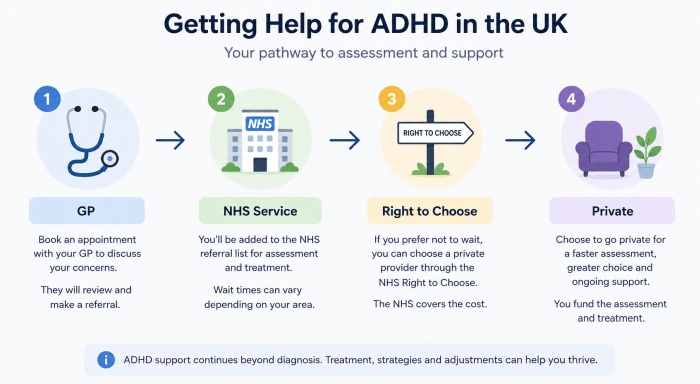
Start with your GP
Your GP is the typical first step. They cannot diagnose ADHD themselves, but they can listen to your concerns and refer you for a specialist assessment.
It helps to prepare: note down specific examples of how your difficulties affect your daily life, at work, at home and in relationships, including anything you remember from childhood.
Some people find it useful to complete a self-report ADHD screening questionnaire beforehand, though please note that a positive result on such a questionnaire is not a diagnosis.
The City & Hackney Adult ADHD Service (local NHS route)
Adults aged 18 and over who are registered with a City and Hackney GP can be referred to the City & Hackney Adult ADHD Service, run by East London NHS Foundation Trust (ELFT). The service offers assessment and diagnosis, medication initiation and review, and post-diagnostic psychoeducation.
Referrals are made by your GP through your local medical practice and you cannot refer yourself. As with many services in Hackney and across the country, there is currently a waiting list. Ask your GP for the current referral route and approximate waiting time, as this varies from time to time.
NHS Right to Choose
In England, you have a legal right to choose which approved provider your GP refers you to for many services, including ADHD assessment. This is known as “Right to Choose”, and it has helped some people access an assessment sooner than through their local service.
That said, the picture in 2025–26 has become more complicated. Facing very high demand, many local commissioners (Integrated Care Boards) have set limits on how many assessments Right to Choose providers can carry out, and several areas have paused or capped new bookings.
Therefore, availability varies a great deal depending on where you live. Before assuming Right to Choose is a fast route, ask your GP whether it is currently open for your area and what the realistic wait time looks like.
Paying for a private assessment
A private assessment is another option, and waits are usually much shorter. Costs vary widely but are commonly from several hundred pounds to around £1,200 or more for an adult assessment, with medication adjustments and follow-ups charged separately. Standard private medical insurance does not typically cover ADHD.
If you go private, check the quality carefully. Look for an assessor registered with the GMC or HCPC, an assessment that follows recognised UK standards (such as the UK Adult ADHD Network’s quality standard), and clarity about what happens next.
Ask about “shared care” which is an arrangement where your NHS GP takes over prescribing after a private diagnosis. Not every GP practice will agree to this, and it does affect the long-term cost.
Is ADHD being over-diagnosed? A balanced view
You may have seen the claim that “everyone has ADHD nowadays.” It is worth looking at fairly, because it affects how people feel about seeking help.
Concerns about assessment quality are real. A 2023 BBC Panorama investigation reported that an undercover reporter received ADHD diagnoses from some private clinics after short online assessments, even though an NHS psychiatrist did not consider that he met the threshold. The programme drew heavy criticism, including from ADHD charities who felt it painted the whole sector unfairly and risked adding stigma.
On the other side, a 2026 consensus paper in the British Journal of Psychiatry, bringing together academics, clinicians and people with lived experience, found no robust evidence that ADHD is over-diagnosed in the UK. Its authors argue that the more pressing issues are unmet need, long waits and missed or mistaken diagnoses, with many adults never recognised at all.
The thread that connects both of these views is quality, not quantity. The sensible takeaway for you is not to worry about headlines, but to make sure any assessment you have is a thorough one, carried out by a suitably qualified assessor.
It is also OK to hold two ideas at once: ADHD can be understood as a difference in how the brain works, and as something that causes real difficulty deserving support. Both framings can be true.
ADHD in adults
For a long time, ADHD was seen as a childhood condition affecting mainly boys. We now understand it very differently as it does persist into adulthood, and it is widely under-recognised, particularly in women and in adults who learned to “mask” their difficulties.
Masking means covering up struggles by working twice as hard, staying quiet, or building elaborate systems to keep up. It can be exhausting, and it often hides how much someone is struggling. In adults, ADHD may look less like obvious hyperactivity and more like inner restlessness, chronic overwhelm, difficulty finishing tasks, or emotional ups and downs.
That is why a late diagnosis can be such a mix of feelings. It can provide relief at an explanation, but also grief for the years spent believing the problem was a personal failing.
If that sounds like you, please know your difficulties are real, and support is available whether or not you ever pursue a formal label. Therapy can really help with that.
ADHD therapy in Hackney at Space To Be You
If you decide therapy might help, here is what working with us looks like.
Our therapy rooms in Hackney
We offer sessions from our therapy rooms in Hackney (E8), on the St Joseph’s Hospice site on Mare Street. The rooms are calm, private and quiet, designed so you can feel at ease. We also offer online appointments if that suits you better, so distance or a busy week doesn’t need to get in the way.
Finding a therapist who understands ADHD
Feeling understood by your therapist makes a real difference. Many of our therapists have experience supporting neurodivergent adults, including people with ADHD, and we will help match you with someone who fits what you are looking for. If it would help, tell us at the start that ADHD support is what you need, and we will take it from there.
You can browse our therapists or click on the green Find a Therapist button below.
Fees and how to begin
Fees vary depending on the individual therapist you see, but are typically between £50 to £130 for a 50-minute session, usually held once per week.
Simply get in touch and we’ll connect you with a suitable therapist who will help you take the next step, at your own pace.
When to get urgent help
Living with undiagnosed or unsupported ADHD can bring intense distress, and difficult feelings are nothing to be ashamed of.
Therapy is not an emergency service, though, so please use the right support if things feel overwhelming.
If you need urgent help but it is not an emergency, call NHS 111 and choose the mental health option to reach your local crisis line.
The Samaritans are also available day and night on 116 123.
If you or someone else is in immediate danger, call 999 or go to your nearest A&E.
You deserve support, and reaching out is a sign of strength, not weakness.
Frequently asked questions
Can a counsellor or therapist diagnose ADHD?
No. In the UK, an ADHD diagnosis comes from a suitably qualified specialist, usually a psychiatrist, through a formal assessment. Counsellors and psychotherapists can offer valuable support around ADHD, but they cannot diagnose it or prescribe medication.
Does therapy work for ADHD, or do I need medication?
For adults whose symptoms cause significant difficulty, NICE recommends medication as the first-line treatment. Therapy does not change the underlying neurology, but it can help with coping strategies, self-understanding, and the anxiety or low mood that often accompany ADHD. NICE also recognises structured psychological support, which may include CBT, for people who choose not to take medication or use it alongside.
I’m on an NHS waiting list, can therapy help me while I wait?
Yes. Waits can be long, and therapy can help you cope in the meantime by managing distress and self-doubt, building practical strategies, and thinking through whether to pursue a diagnosis. It supports how you feel and function now, and is not a substitute for assessment.
What’s the difference between ADHD therapy and ADHD coaching?
Therapy is a clinical talking treatment that addresses emotional wellbeing, mental health and self-understanding. ADHD coaching is practical support focused on routines, time and organisation. They can complement each other, and coaching is support rather than clinical treatment.
Can I have therapy for ADHD without a formal diagnosis?
Yes. You do not need a diagnosis to start therapy. Many people come to us while they are unsure, waiting for assessment, or after deciding not to seek a formal label. Therapy responds to your difficulties as you experience them.
How do I get an ADHD assessment in Hackney?
Start with your GP, who can refer you. Hackney adult residents can be referred to the City & Hackney Adult ADHD Service, run by East London NHS Foundation Trust. You can also ask your GP about NHS Right to Choose or consider a private assessment. Availability and waits change, so check the current position with your GP.
Is ADHD therapy available online or only in person?
We offer both in-person sessions in Hackney and online appointments. Many people find online therapy just as helpful, and it can make regular sessions easier to keep.
NEED HELP CHOOSING AN ADHD THERAPIST?
If you’d like to be matched with an ADHD therapist, please click below or contact one directly on our therapist directory page.