
Depression Counselling in Hackney E8
Written by Izabela Hunter, MA, BACP, UKCP, Child, Adolescent & Adult Psychotherapist
Last reviewed: July 2026
Looking for help with depression?
If you’re looking for depression counselling in Hackney, Space To Be You have many counsellors and psychotherapists who can help.
We’re located on Mare Street, in the heart of Hackney, close to several train and bus routes.
Feeling low or depressed is not a weakness or a failure, and you don’t have to wait until you reach crisis point to get support.
The counsellor-client fit matters to us, and we’re here to help you find the right person.
If you’d like to be matched with a depression counsellor, click below and fill in your details.
What is depression?
 Depression is more than a bad day or a difficult week. It’s a low mood that lingers, and it affects how you think, how you feel, and how you cope with daily life.
It’s also very common, and, importantly, it’s treatable. Whatever you’re feeling, you are not alone.
Depression can look very different from one person to the next. While some people might feel sad, others might feel numb, irritable, or simply exhausted.
Common signs of depression include:
– persistent low mood or sadness
– losing interest in things you used to enjoy (sometimes called anhedonia)
– feeling tired or low on energy
– changes in sleep, appetite, or weight
– poor concentration or memory
– feelings of hopelessness, guilt, or low self-worth
It can also appear at particular times, such as postnatal depression after having a baby, or Seasonal Affective Disorder (SAD) in winter.
How do I know if it’s depression or just low mood?
Everyone feels low sometimes, and a low mood often goes away within a few days, especially once a stressful event has passed.
Depression is more persistent. As a rough guide, when low mood meets all of the below criteria, then it may be classed as depression:
– lasts most of the day
– happens nearly every day
– continues for two weeks or more
– and starts to affect your work, relationships, or daily routines
You don’t need to work this out on your own, or reach a diagnosis before asking for help. Low mood counselling in Hackney can help you make sense of what’s going on, whether or not it turns out to be clinical depression.
Why does depression make everything feel so hard?
Depression has a way of feeding itself.
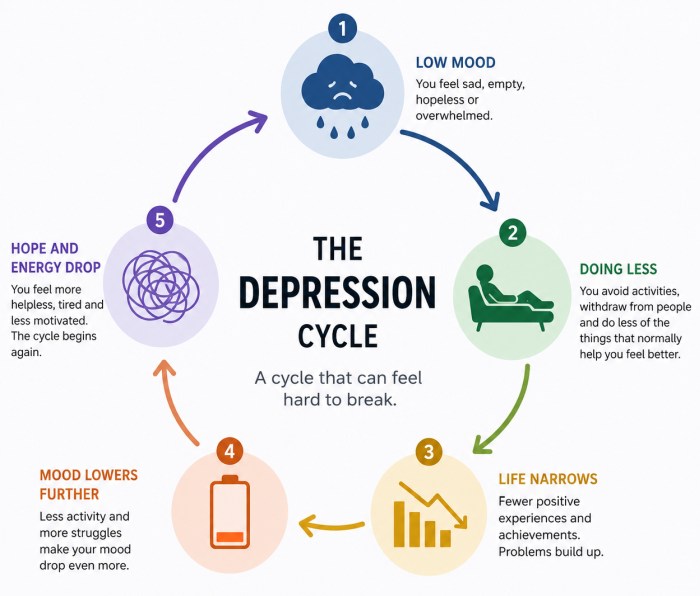
When your mood drops, you naturally do less.
For example, you cancel plans, withdraw, and let things slide.
But doing less removes the small sources of reward and connection that lift mood, so you feel worse, and then do even less.
This loop is one reason depression is so hard to shift by yourself. It isn’t laziness, and it isn’t weakness. It’s a self-reinforcing pattern.
The encouraging part is that patterns can be changed. Much of depression counselling is about gently breaking this cycle, one small step at a time.
What could be behind your depression?
Depression rarely comes from nowhere. Sometimes it builds slowly, and sometimes it’s tied to something specific that is worth exploring.
For some people, low mood sits alongside anxiety, as the two often go hand in hand. For others it’s linked to unresolved grief and bereavement, chronic stress or burnout, past trauma, or the emotional ups and downs that can come with ADHD.
How does counselling help with depression?
Depression counselling in Hackney gives you regular, confidential time with a trained professional to understand what keeps your depression from clearing, and how to change it.
Depending on the approach, counselling can help you:
– notice and question unhelpful patterns of thinking
– rebuild your motivation and activity, one step at a time
– understand relationships or past experiences that feed low mood
– learn practical coping mechanisms you can use in your daily life
It’s worth being honest about what to expect, however. Counselling isn’t an instant fix, and most people need several sessions, and the work you do between sessions matters as much as the hour itself. But for many people it makes a real difference.
What types of counselling help with depression?
There’s no single “best” therapy for depression. A good depression counsellor matches the approach to you, and NICE, which sets treatment standards for the NHS in England, recommends a range of talking therapies rather than one fixed route.
Depending on what suits you, a therapist might draw on CBT therapy (which targets unhelpful thoughts and behaviours and has strong links to depression), behavioural activation (slowly rebuilding rewarding activity), counselling for depression (a person-centred space to explore difficult feelings), interpersonal therapy (focusing on relationships and life changes), psychodynamic therapy or integrative therapy (exploring how past experiences shape how you feel now).
You don’t need to choose the right one before you start. The first session, normally referred to as a consultation or an assessment, is where you and your counsellor talk it through and agree a plan together.
Should I see a depression counsellor?
Many people wonder whether their low mood is “bad enough” to justify support. You don’t have to be at rock bottom to see a counsellor.
It might be worth reaching out if any of the following are true:
– your low mood has hung around for two weeks or more
– you have lost interest in things you used to enjoy
– you are struggling to function at work, at home, or as a parent
– you feel hopeless, worthless, or constantly exhausted
– you are leaning on alcohol or other substances to cope
None of these mean something is “wrong” with you. They’re simply signs that support could help, and the earlier you reach out, the better.
What are your options for depression counselling in Hackney?
You have real choices, and some are free.
City and Hackney NHS Talking Therapies offers free, confidential therapy you can refer yourself to, with no GP referral needed if you’re 18 or over and registered with a local GP. It’s well suited to depression and anxiety. The main trade-offs are the waiting time, which can be several weeks, and less choice over who you see.
Private depression counselling in Hackney at Space To Be You suits people who want quicker access, a choice of therapists, and room to work at their own pace. Fees typically range from £50 to £130 for a 50-minute session, and most therapists offer a free introductory call so you can ask questions first.
We’re on Mare Street in Hackney (E8), and our therapists offer sessions in person or online. If cost is a barrier, the free NHS route above is a genuine option, and some people use both, starting privately while waiting for an NHS place.
What can I expect from depression counselling?
Starting counselling can feel daunting, so here’s what usually happens.
Your first session is usually an assessment. It is a relaxed conversation about what’s been going on, a little of your history, and what you’d like to change. Together you agree a plan and a way of working.
After that, sessions are typically weekly and last around 50 minutes. Counselling is reviewed as you go, and you and your counsellor decide together when the time is right to finish.
Everything you share is confidential. The one exception is if there’s a serious risk to your safety or someone else’s, when your counsellor may need to share information to keep people safe. They’ll explain this at the start.
When should you seek help for depression?
Reaching out early is sensible, not a last resort. It’s worth acting sooner rather than later if your mood is sinking, you feel hopeless, or daily life is becoming hard to manage.
If depression ever brings thoughts of harming yourself, please treat it as urgent and reach out now:
Samaritans – call 116 123 which is free any time, day or night.
NHS 111 – call 111 and select the mental health option for urgent help.
Emergencies – call 999, or go to your nearest A&E department if you or someone else is in immediate danger.
How to find the right depression counsellor in Hackney
- Search our directory – Our Hackney therapists directory lists counsellors and psychotherapists experienced in depression and low mood.
- Check credentials – Look for registration with the BACP, UKCP, BABCP, or NCPS. All of our therapists are registered with a UK body, except trainees, who are clearly labelled as such in their profile.
- Book an initial consultation – This lets you see whether the client/counsellor fit feels right. It’s just a conversation, not a commitment.
- Consider the approach and practicalities – Choose the type of counselling, location, and timing that suit you.
If the first counsellor isn’t quite right, keep looking until you find someone you feel comfortable with; they won’t be offended.