
Anxiety Therapy in Hackney E8
Space To Be You have some of the best anxiety therapists in Hackney to choose from.
The therapist-client fit is important to us and we’re here to help you find the right therapist.
If you’d like to be matched with a therapist, please click the button below and fill out your details.
Alternatively, you can search for anxiety therapists on our directory of psychotherapists and counsellors page.
Written by Izabela Hunter, MA, BACP, UKCP, Child, Adolescent & Adult Psychotherapist
Last reviewed: July 2026
Looking for help with anxiety?
If you are looking for therapy for anxiety, you are probably not feeling your best right now. Maybe your mind won’t switch off, you might be struggling with sleep, or your chest might feel tight for no reason. You may have had a panic attack and it might have frightened you.
Whatever brought you here, there are two things worth saying first: 1) what you are feeling is common, and 2) that feeling can be helped by therapy.
Around 1 in 12 adults in England now suffer from generalised anxiety disorder (GAD), according to the Adult Psychiatric Morbidity Survey published in 2025, so you are not alone.
This page aims to explain your options in plain English:
- the types of therapy that can help you with anxiety
- how long it might take to see the benefits
- what the typical costs are
- the free NHS route in Hackney
- how to choose a therapist you trust
There is no pressure here, just clear information to help you decide your next step.
Understanding anxiety
Everyone feels anxious from time to time, so anxiety is a problem only when it becomes a regular occurrence, feels hard to control, or it starts to affect your day-to-day life, sleep, relationships, or work.
The good news is that anxiety is well understood and is normally quite treatable.
You do not need to reach the point of crisis to find help; many people begin therapy simply because their anxiety or worry has become too much or is overwhelming.
Common signs and symptoms
Anxiety normally shows up in the body as well as the mind. For example people might notice some of the following symptoms:
- Physical – a racing or palpitating heart, a tight chest, shortness of breath, dizziness, muscle tension, stomach problems, or trouble sleeping
- Emotional – feeling on edge, irritable, overwhelmed, or detached in some way
- Cognitive – having racing thoughts, constant worrying, expecting the worst, difficulty concentrating, going over the same thing again and again
- Behavioural – avoiding being around people, places, or situations that feel risky, or relying on safe habits to get through the day
With anxiety you will mostly recognise the physical symptoms, which is normal. Anxiety is a whole-body response, and the physical signs of it are often what bring people to seek an anxiety therapist.
Types of anxiety that Space To Be You can help with
Anxiety can have several forms and you don’t need a formal diagnosis to begin therapy, but it can help to understand the language and jargon:
- Generalised Anxiety Disorder (GAD) – persistent worry across many areas of your life
- Social anxiety – an intense fear of being watched or judged by others
- Panic attacks and panic disorder – sudden surges of physical fear, often when you might fear the panic attacks themselves
- Health anxiety – repeated worry about being ill
- Phobias – a strong fear of a specific object or situation
These forms of anxiety often overlap, and they often sit alongside low mood or depression, which is one reason a proper assessment matters more than trying to diagnose yourself.
When to consider professional support
There is no single threshold, but it may be time to talk to someone if any of the following are true:
– Worry or fear has lasted several weeks and is not going away
– It is affecting your sleep, work, relationships, or appetite
– You avoid things you previously managed with
– You are using alcohol or other things to cope
Seeking help early tends to make things easier, not harder. You are allowed to ask for support before things feel unbearable.
Does therapy work for anxiety?
Yes! Talking therapy is one of the most effective treatments for anxiety, and it is also what the NHS recommends first for most people.
Furthermore, The National Institute for Health and Care Excellence (NICE) sets out what they call a “stepped-care” approach for anxiety. Their method is quite simple:
> Start with the least intrusive support that is likely to help, and step up to more intensive treatment only if you need it.
> For milder anxiety, that might mean guided self-help.
> For anxiety that is having a strong impact on your life, NICE recommends a high-intensity psychological therapy such as cognitive behavioural therapy.
 It is also worth knowing what the evidence does not say: NICE notes there is no clear evidence that medication works better than psychotherapy or counselling for generalised anxiety, so the choice should be yours after a proper conversation with a therapist.
Please note that Space To Be You does not offer medication advice. That is a discussion for your GP or psychiatrist.
It’s also worth pointing out that therapy is not a quick fix, and it is not the same for everyone.
Some people respond well with short, structured, skills-based work. Whereas others gain more from longer, exploratory type therapy that looks at underlying patterns.
Both are valid, and a good therapist will help you find the right fit.
Types of anxiety therapy available in Hackney
There is no such thing as a “best” type of therapy for anxiety. The most helpful approach depends on your symptoms, your history, and what suits you as a person. Here is a neutral overview of the main anxiety counselling options:
Cognitive Behavioural Therapy (CBT)
CBT therapy is a structured, practical therapy with the strongest evidence for helping with anxiety. It looks at the links between your thoughts, feelings, and behaviour, and it gives you tools to break the cycle of worry. It can often include what is called “graded exposure”, where you face situations gradually and safely. Many people find CBT reassuring because it is focused and goal-led.
Counselling and person-centred therapy
Person-centred counselling offers a supportive, non-judgemental space to talk things through at your own pace. Rather than following a set programme, it follows you where you want to go in therapy. It can suit people who want or need to feel heard and understood, and who value exploring their feelings rather than working towards a structured plan.
Psychodynamic therapy
Psychodynamic therapy looks deeper and further back in time. It explores how earlier experiences and relationships can often shape the patterns that are showing up in your life now. It tends to be longer-term type of therapy and is well suited to people who sense their anxiety has roots that they would like to explore and understand.
Integrative and other therapeutic approaches
Many therapists work integratively, so integrative therapy draws on more than one approach to fit you rather than the other way round. Some related therapies include: Acceptance and Commitment Therapy (ACT), mindfulness-based counselling, applied relaxation techniques, and EMDR where anxiety is linked to trauma.
Which approach is right for me?
If this feels like a lot, don’t worry, you’re not expected to pick the perfect therapy on your own; a therapist will help you do that.
Also, the single most important factor in whether therapy helps is the quality of the relationship between yourself and your therapist, not the type of therapy.
A good first step is a conversation, not a commitment. Almost all of our Hackney anxiety therapists offer a free initial consultation to help match you with the right approach and person.
How long does anxiety therapy take?
This is one of the most common questions, and the honest answer is: it depends.
If you are having CBT for generalised anxiety, NICE suggests a course of around 12 to 15 weekly sessions. Milder anxiety may improve with fewer, lower-intensity sessions. More complex difficulties can take longer, especially with the exploratory type therapies mentioned above.
Sessions normally last 50 minutes and are typically weekly, at least to begin with.
These numbers are just a guide though and your therapist will agree a plan with you and you will review it together as you go.
NHS vs private anxiety therapy in Hackney
You have more than one route to support, and it is worth understanding both before you decide. Being upfront about the free option matters more to us than winning your business.
NHS Talking Therapies (City & Hackney)
If you live in or are registered with a GP in the boroughs of the City of London or Hackney, you may be eligible for free talking therapy through City and Hackney Talking Therapies. Their service covers neighbourhoods including Clapton, Dalston, London Fields, Shoreditch, Stoke Newington, Hoxton, and Homerton.
You do not need a GP referral and you can refer yourself directly through their website. They will try to provide an initial telephone assessment within about two weeks. The service is free, evidence-based, and a solid option for many people.
The trade-offs are that there’s less choice over your individual therapist, a possibly significant wait for treatment after assessment, and a focus mainly on shorter-term, NICE-recommended approaches, such as CBT.
Private therapy
Private anxiety therapy, which is what Space To Be You Hackney offers, usually means much quicker access, a choice of many therapists (we have over 60), and the ability to work in the way and for the length of time that suits you, including longer term exploratory work. What you are paying for is choice, continuity, and flexibility.
The right route is the one that fits your needs, your timeframe, and your budget. For some people that is the NHS, for others it is private therapy, for some it is starting privately while on an NHS waiting list.
How much does private anxiety therapy cost?
In Hackney, private individual anxiety psychotherapy or counselling can cost between £50 to £130 per 50-minute session, depending on the therapist’s experience and the type of therapy. Lower-cost options exist, including sliding-scale fees and sessions with supervised trainee therapists at reduced rates.
See our Hackney therapists page for individual therapist profiles, fees and more information
What to expect from your first session
Your first counselling or psychotherapy session might feel daunting, so here is what usually happens:
> The first appointment is mainly an assessment; a chance for you and the therapist to understand what is going on and what you want from therapy.
> You will not be expected to share everything at once and you set the pace. The therapist will explain how they work, answer any questions you might have, and talk through logistics, confidentiality and the limits of therapy.
> Importantly, there is no obligation to continue. If the fit does not feel right, you can simply say so and change therapist. That is normal and expected, so don’t feel you are being rude. A good therapist will want you to find the right support, even if that is not them.
How to choose the right Hackney anxiety therapist
Choosing a therapist can sometimes feel like the hardest part, however these checks should help make it simpler and safer.
Look for proper registration or accreditation – In the UK, make sure you look for a therapist or counsellor registered or accredited with a recognised professional body such as the BACP, UKCP, BABCP, or NCPS. Registration with these bodies means that they meet training, ethics, and supervision standards, and are accountable. The good news is that every therapist on our website is either registered or accredited with a UK body. The exception is trainee therapists who are allowed to practise, but will be marked clearly as trainee.
Ask a few simple questions – It is fine to ask about their experience counselling for anxiety, the approach they would use, their fees, and what a typical course looks like. A good therapist will be happy to answer these questions.
Trust the relationship – Beyond credentials, pay attention to how you feel with them. Do you feel listened to and respected by them? That sense of fit is one of the best predictors of whether therapy will help.
In-person vs online anxiety therapy
Both in-person and online therapy work well, and the research finds the results very similar for many people with anxiety.
In-person sessions suit people who value a dedicated space away from home and find face-to-face contact important.
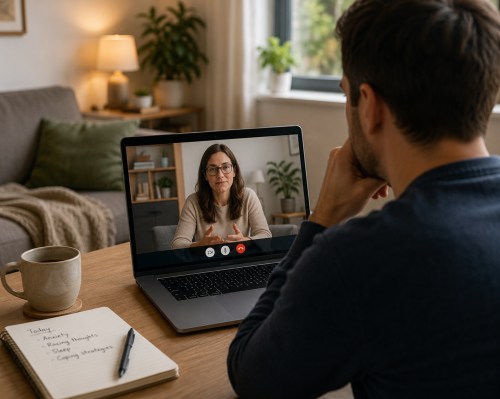
Online therapy suits people with busy schedules, responsibilities at-home, limited transport, or anxiety that makes leaving home harder. Many people mix the two.
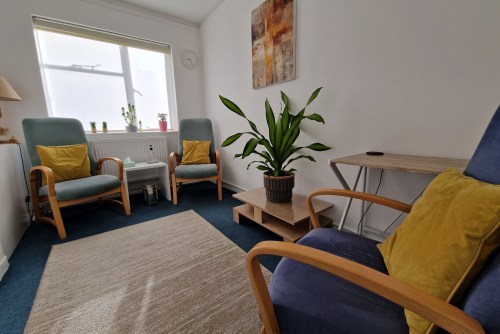
For Hackney residents or those in neighbouring boroughs such as Islington, Tower Hamlets and the City, in-person sessions are a great option at our therapy rooms in Mare Street, E8.
Benefits of anxiety therapy in Hackney
Space To Be You is a counselling and psychotherapy practice based in Hackney E8, offering anxiety therapy in person and online. Our team of over 60 registered and accredited therapists includes practitioners trained in CBT, counselling, psychodynamic, and integrative approaches, so we can match you to the right person and method rather than offering one size for all.
Our clinical lead, Izabela Hunter, is a BACP and UKCP -registered psychotherapist with eight years of experience supporting people with anxiety and other issues.
Every therapist at Space To Be You is registered with a recognised professional body and works within their ethical frameworks.
We have served clients since 2020 and have over 60 therapists working from our quiet and confidential centre.
We are easy to reach from across Hackney, including Dalston, London Fields, Clapton, Stoke Newington, Shoreditch, Hoxton, and Homerton, as well as neighbouring Islington and Tower Hamlets.
Frequently asked questions
What’s the difference between CBT and counselling?
CBT is structured and skills-based, focused on changing unhelpful thought and behaviour patterns over a set number of sessions. Counselling is more open and exploratory, following your pace and feelings rather than a fixed programme. Both can help with anxiety but you should choose what works best for you.
How many sessions will I need?
It can vary. For generalised anxiety, NICE suggests around 12 to 15 weekly CBT sessions. However milder anxiety may need fewer sessions and complex anxiety may need more sessions. Your therapist will agree a plan with you and review it as you progress.
How much does anxiety therapy cost in Hackney?
Private sessions typically range from around £50 to £130 per 50-minute session, with lower-cost sliding-scale and trainee options available. NHS Talking Therapies are free.
Can I get anxiety therapy on the NHS in Hackney, and do I need a GP referral?
Yes. If you live in or are registered with a GP in the City of London or Hackney, you can access free NHS Talking Therapies. You do not need a GP referral and you can refer yourself directly. Most people are assessed within about two weeks.
What happens in the first session?
The first session is mainly an assessment session. You and the therapist explore what is going on and what you want from therapy, at a pace you control. You are not obliged to continue if the client/therapist fit is not right.
Does therapy actually work for anxiety and panic attacks?
For many people, yes it does. Talking therapies, especially CBT, are recommended first-line treatments for anxiety in the UK, with a strong evidence base. Results vary between individuals, but finding the right therapist is the most important.
In-person or online, which is better?
Both work well, and research finds them comparable for most people. In person suits those who value a dedicated space whereas online suits those needing flexibility. It comes down to your own preference and circumstances.
How do I know if I need therapy for my anxiety?
Consider therapy if worry or fear has lasted several weeks, is affecting your sleep, work, or relationships, or is leading you to avoid things. You do not need to be in crisis to deserve support.
What type of therapist should I look for, and what do BACP and UKCP mean?
Look for registration with a recognised body such as BACP, UKCP, BABCP, or NCPS. These bodies set standards for training, ethics, and supervision, which means your therapist is properly qualified and accountable.
Getting started
Taking the first step is often the hardest part, and you have already started by reading this far.
If you would like to talk things through with no pressure, you can book a free initial consultation with us.
It is a relaxed conversation to understand what you are looking for and help match you with the right therapist and approach, whether that turns out to be with us, the NHS, or elsewhere.
If you need urgent help
This page is for general information and is not a substitute for individual medical or mental-health advice. If you are in crisis or worried about your safety, please reach out now:
– NHS 111 – for urgent but non-emergency mental health support (call 111 and select the mental health option).
– Samaritans – call 116 123, free, any time, day or night.
– Emergency services – call 999 if you or someone else is in immediate danger.
NEED HELP CHOOSING AN ANXIETY THERAPIST?
If you’d like to be matched with a therapist, please click below or contact one directly on our therapist directory page.