
Therapy for OCD in Hackney E8
Looking for therapy for Obsessive Compulsive Disorder (OCD)?
If you’re looking for OCD therapy in Hackney, Space To Be You have many therapists who work with this condition.
Many people carry the symptoms of OCD privately for years before telling anyone. However, OCD is a widely recognised and very treatable condition, and therapists hear about obsessions and intrusive thoughts far more often than you might think.
We’re on Mare Street, in the heart of Hackney (E8), with sessions available in person or online.
Alternatively, you can search our Hackney therapist directory.
What is OCD?
OCD is a diagnosable mental health condition. It is not a personality quirk, and it is not simply a preference for tidiness.
“A bit OCD” is a common phrase you might hear, but it describes something quite different from the condition itself.
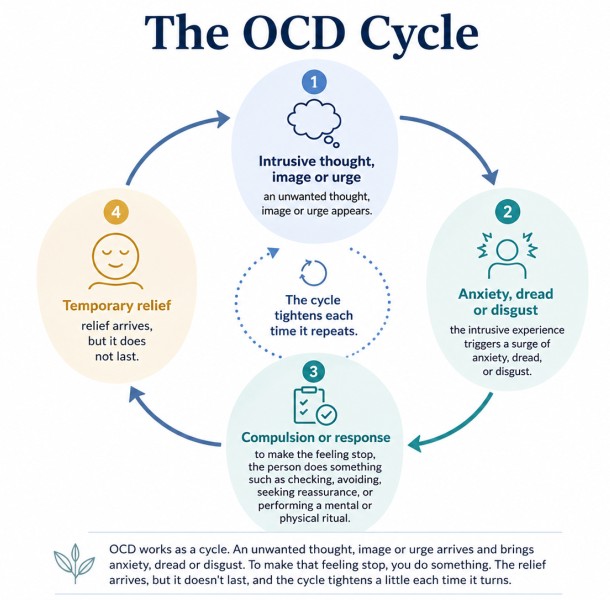
OCD works as a cycle:
- An unwanted thought, image or urge arrives
- It brings with it a feeling of anxiety, dread or disgust
- To make that feeling stop, you do something
- The relief arrives, but it doesn’t last
- The cycle tightens a little each time it turns
Themes of contamination (things need to be cleaned) and symmetry (this must line up) are real, but they are far from the whole picture. Plenty of people with OCD have never washed their hands more than the average person, and OCD can manifest in many different ways.
What are obsessions?
Obsessions are intrusive thoughts, images or urges that keep returning to your mind despite you not wanting them and you actively trying to push them away. They tend to attach to things that matter the most to you, such as your safety, your character, health and contamination, order, or the people that you love.
What are compulsions?
Compulsions are what you do to make the obsessions stop. Some are visible, such as washing, checking locks, checking the hob, or arranging things until they feel right.
However, many are not visible at all, such as replaying a memory to be sure of what happened, repeating a phrase in your head, mentally reviewing whether you are a good person, or asking questions of a partner, on a forum or a search engine.
Mental compulsions are exhausting, and they are much easier to hide.
OCD often sits alongside anxiety, which is worth exploring with a professional if both feel familiar.
When to seek help with OCD through therapy
Everyone double-checks things, and everyone overthinks from time to time. The difference usually shows up in how much mental space they take up and how much distress they cause.
It may be worth talking to a Hackney OCD therapist if:
- The thoughts, and your responses to them, take up a significant part of your day
- The feeling is distressing to you, rather than mild irritation
- You avoid places, people or situations to stop the thoughts from starting
- You constantly seek reassurance, but the relief never seems to stick
- You’ve built rules or routines that don’t seem right, but feel impossible to drop
- Your life feels like it has narrowed, but you’ve stopped mentioning it to anyone
This above list is not a diagnosis, and it isn’t meant to be used as one. Only a qualified OCD therapist can tell you whether what you’re experiencing is OCD, and that conversation will be more useful than any checklist.
What do intrusive thoughts actually mean?
Intrusive thoughts are universal to all humans. The majority of people have had a strange, disturbing, or even violent thought come out of nowhere, dismissed it, and forgotten it hours later.
What differs in OCD isn’t the thought, it’s what happens next: the thought is treated as meaningful, it causes real distress, and something has to be done about it.
 This is also why the thought is often the opposite of the person’s values. Therapists describe these thoughts as “ego-dystonic”, which means they are contrary to who you are.
That clash is exactly why they stick and why they frighten you. For example a gentle person might get violent images, a devoted new parent gets thoughts about harm coming to their baby, someone with a strong faith gets blasphemous ones.
These themes cause people to feel too ashamed to say them out loud. Here are some examples:
- Harm OCD – involves fears of hurting someone, often someone loved
- Relationship OCD – brings relentless doubt about a partner or the relationship itself
- Others centre on contamination, checking, religious or moral doubt
- “Pure O” – refers to purely obsessional OCD where the compulsions are in the mind, and difficult for others to see
This part is important to read: Having these thoughts does not mean you want to act on them, and it does not mean you will. People with harm-themed OCD are not at increased risk of doing what they fear. The distress itself is the most obvious evidence that the thought runs contrary to everything you value.
Counsellors and psychotherapists who work with OCD have heard these themes many times before. You will not be the first, and nothing you tell them will shock them.
What causes OCD?
There is no single cause, and nothing you did brought it into being. There are often common themes that can contribute to OCD:
- Temperament plays a part, and a conscientious, highly responsible sort of mind is common.
- Family history
- Periods of sustained stress matter too
- OCD often surfaces or worsens during change, such as illness, bereavement, becoming a parent, a house move, or a demanding stretch at work
Something manageable for years can tip over when everything else is already stretched.
Differences in brain function are still being researched, however there isn’t enough evidence to provide a simple explanation. What matters most is that OCD responds to treatment however it began.
Different types of therapy for OCD
The evidence here is unusually clear: NICE and the NHS recommend cognitive behavioural therapy (CBT) that includes exposure and response prevention (ERP) as the initial treatment for OCD.
Medication (usually an SSRI) may also form part of treatment, but that is something to discuss with a GP or psychiatrist rather than a counsellor or psychotherapist who are not able to prescribe medication.
ERP works by slowly approaching the things that set off the anxiety, while not carrying out the ritual that usually turns it off. It happens at a pace you agree with your therapist, and is never seen as a test that you pass or fail.
Space To Be You offers CBT in Hackney, the therapy approach recommended for OCD. Training and experience of therapists will vary, so when you book an initial consultation we recommend you ask directly about their experience with OCD.
Here are some other therapies that might be suitable for OCD in Hackney:
- Cognitive Behavioural Therapy (CBT) – the structured approach recommended for OCD itself
- Psychotherapy – longer-term work on patterns that keep repeating
- Integrative counselling – a blend of approaches shaped around you
How does OCD affect your work, health and relationships?
The biggest cost is time. Checking, rereading, and reviewing can absorb many hours, and most of that isn’t visible to the people around you.
Mental rituals can be tiring in a way that’s hard to explain. You might look composed in a meeting, but inside you’re running the same loop for the ninth time that morning.
Relationships can be affected too. Partners, housemates or family can become part of the pattern without meaning to, answering the same question again and again.
Avoidance can do considerable damage as you may avoid streets, shops, public transport and conversations with certain people. The list of things you avoid can grow slowly, which is difficult in a borough like Hackney where life is lived at close quarters.
Low mood can often be connected and depression often sits alongside OCD, which is worth exploring with a Hackney OCD counsellor or psychotherapist.
What are the benefits of therapy for OCD?
The first thing most people notice is getting more time back. As the compulsions lose their hold, the hours they previously consumed return, which tends to be noticeable before anything else.
Intrusive thoughts won’t always disappear altogether, but what can change is their grip. The thought appears but you lose the feeling that it’s an instruction you must to obey. That shift is what most people typically mean when they say that OCD therapy has helped.
Following that, avoidance might ease, places and conversations you’ve been navigating around become possible again.
Partners and family stop being drawn into the reassurance loop, which often repairs more than people expect it to.
Then there’s the shame. Saying the thoughts out loud to someone who isn’t alarmed by them is, for many people, the first real relief in years, and it takes the secrecy out of the condition.
How to find the right OCD therapist in Hackney
Research – Start by exploring our Hackney Therapist Directory and creating a shortlist of therapists who have experience with OCD.
Check their registration – Check each therapist’s credentials and specialties on their websites or by contacting them directly. All of our therapists are registered with a UK body, except trainee therapists, which will be clearly labelled in their profile.
Schedule an initial consultation – Many Hackney-based therapists offer a free or low-cost initial consultation. This meeting allows you to get to know the therapist, discuss your concerns, and determine if they’re the right fit for you.
Approaches – Consider therapists with varied approaches. It’s important to find one with experience in the type of therapy you’re interested in or who can adapt their approach to suit your specific needs.
Location and timing – Ensure that the therapist’s location is accessible from Hackney (E8), and choose a time that fits easily into your schedule.
It’s essential to find a therapist you feel comfortable with and who can help you address your concerns.
If the first therapist isn’t the right fit, don’t hesitate to keep looking until you find one that works for you. They will not be offended.
Why is Hackney a good place for OCD therapy?
For a variety of reasons, Hackney might be a beneficial location for OCD therapy.
Hackney is a varied and culturally rich borough of London known for its vibrant community. Individuals seeking OCD therapy may benefit from this diversity because it gives them access to therapists who have worked with clients from various cultures and backgrounds.
Hackney also provides a wide range of mental health resources, including OCD therapists who specialise in various areas and have diverse skills. This enables people to choose a therapist who can address their specific needs and concerns.
As well as this, Hackney’s proximity to central London makes transport and a range of healthcare facilities easily accessible, making it easier for individuals to attend therapy sessions on a regular basis.
Not only that, but Hackney is known for its progressive and accepting culture, which might foster a friendly and open-minded environment for people seeking OCD therapy.
NEED HELP CHOOSING AN OCD THERAPIST?
If you’d like to be matched with a Hackney OCD therapist, please click below or contact one directly on our therapist directory page.